Study figure and data
Retinol: fine-wrinkle scores
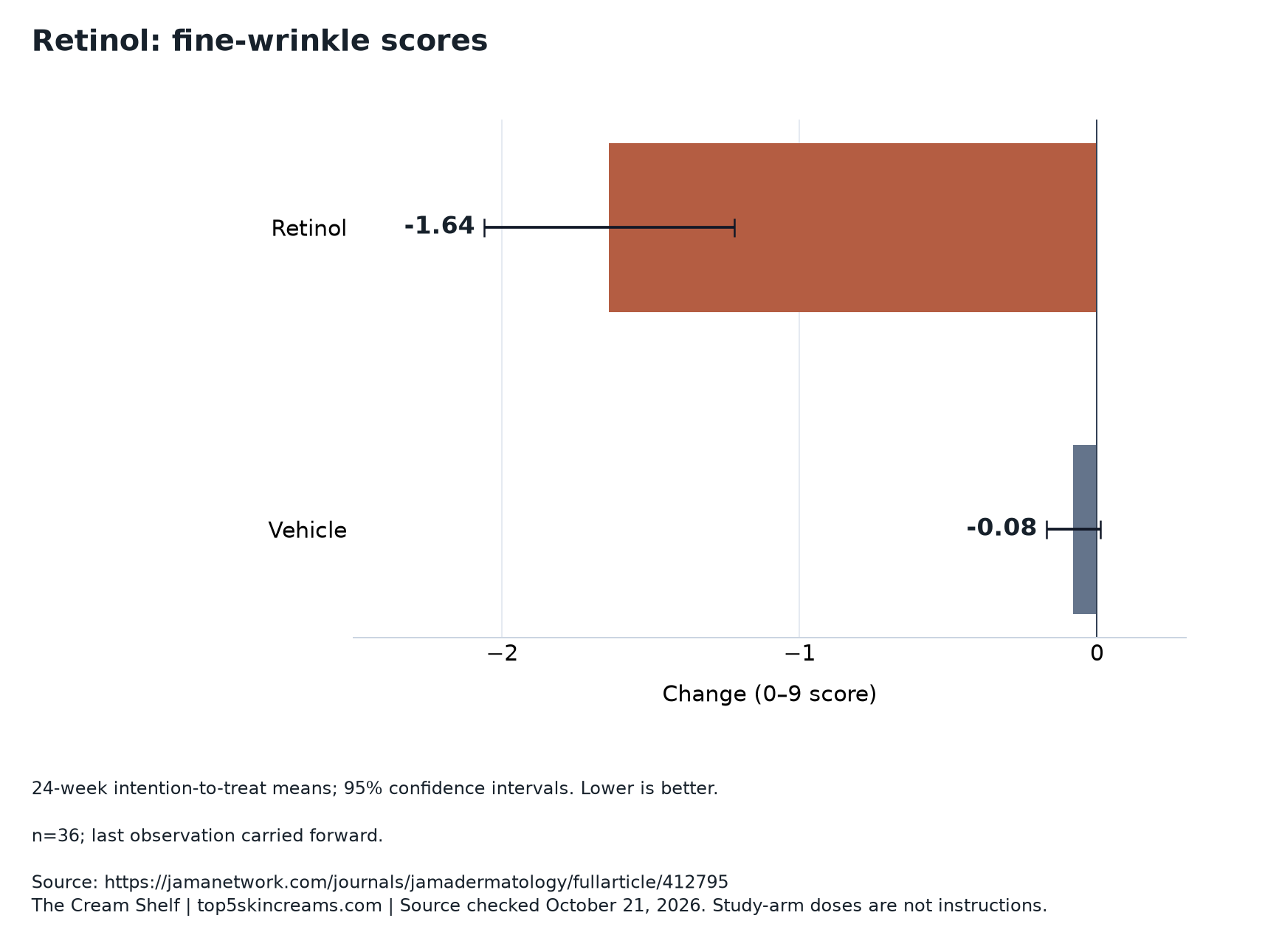
24-week intention-to-treat means; 95% confidence intervals. Lower is better.
n=36; last observation carried forward.
Download chart (PNG)Download data (CSV)Download vector chart (SVG)
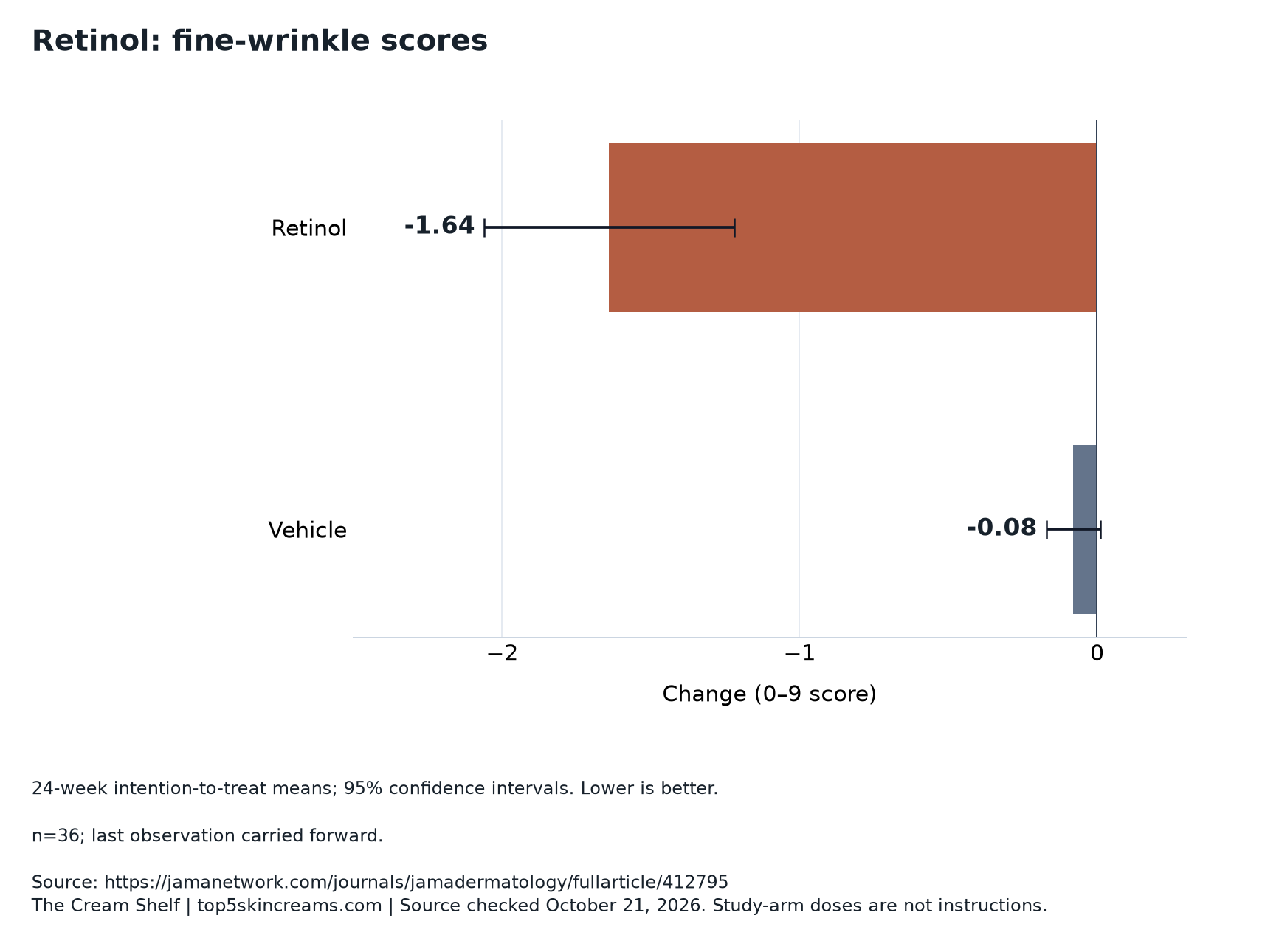
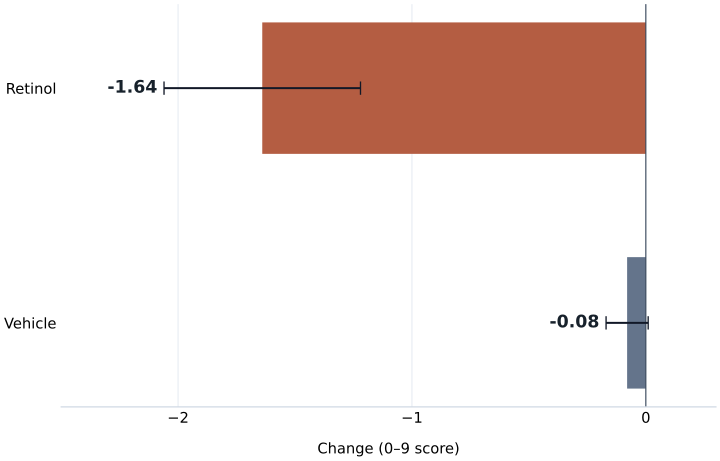
| Study arm | Reported value | 95% confidence interval |
|---|---|---|
| Retinol | -1.64 | -2.06 to -1.22 |
| Vehicle | -0.08 | -0.17 to 0.01 |
Name the comparison before explaining the change
The full article describes randomized paired, protected upper-inner-arm treatment in adults averaging 87: laboratory 0.4% retinol lotion versus matched vehicle, both using a historical moisturizer base. Of 36 enrolled, 23 completed; 13 withdrew, three for irritation/pruritus. Exposure planned up to three times weekly averaged 1.6. Four inventors disclosed conditional patent royalties, not confirmed payment; no separate funding statement was located.
The methodological question is what an active preparation adds relative to its specified comparator under the study conditions. Calling that an incremental contrast is useful because it names the comparison without pretending that the active preparation operates in isolation. The preparation, its carrier, the assessment process and the conditions of observation remain part of the experiment being interpreted.
An editorial reading should therefore begin with a complete sentence describing the comparison, before reaching for an adjective such as effective. Changing the alternative changes the question, even when the active preparation stays the same. The guide to studies, ingredient lists and offers provides a separate place to examine the different documentary purposes of those records. Here, the task is to keep the statistical question intact.
Work through an invented change-score example
Consider an entirely invented experiment with an appearance scale on which lower scores are better. Suppose the active condition changes by minus two points and its comparator changes by minus half a point. The active-minus-comparator difference in change is minus one and a half points. These fictional numbers illustrate subtraction; they are not estimates from the retinol paper or predictions for any product.
Two points describes the active condition's overall observed change. One and a half points describes its additional change relative to the comparator. Attributing the entire two points to the added ingredient would discard the information supplied by the comparison. Conversely, describing the comparator's half-point improvement as a demonstrated effect of its cream would introduce an explanation that the arithmetic itself does not establish.
The sign also needs a definition. A negative contrast favors the active condition only because this example defines a lower score as better and subtracts comparator change from active change. Reverse the subtraction and the sign reverses, without changing the underlying result. An understandable account states the subtraction order and unit together, rather than letting the reader infer whether a minus sign represents benefit or harm.
| Question | Contrast needed | What it addresses |
|---|---|---|
| What changed during exposure? | Later score minus earlier score | Observed change within one condition |
| What did the active preparation add? | Active change minus matched-vehicle change | Incremental change against that comparator |
| What did the base preparation add? | Vehicle change minus no-treatment change | The specified base versus the specified untreated condition |
| Which finished product performed better? | Product A change minus product B change | A direct comparison of the tested finished products |
A comparator is a condition, not an explanation
A matched vehicle is useful because it defines an alternative to the active preparation. Its usefulness does not require calling it biologically inert. That stronger description would itself require evidence. Equally, a change observed under the comparator condition does not isolate the action of the carrier. Time, repeated assessment and other shared circumstances could contribute to a before-and-after difference; identifying their contributions requires additional comparisons or measurements.
Imagine another fictional study in which both conditions improve equally. One possible interpretation is that the added component contributes little under those conditions. That result would not, by itself, tell us whether the shared preparation helped both sides, whether an unrelated influence affected both, or whether measurement behavior produced the apparent change. Several explanations can fit the same pair of averages. The design determines which explanations can be separated.
Adding an untreated condition could address a further question, but it would also require careful definition: untreated does not automatically mean unobserved, untouched or free of every other exposure. A sound comparison records what each condition actually entails. The guide to moisturizers and product roles addresses everyday category distinctions; a clinical comparator needs the more exact description required by its research question.
Preserve the information carried by a pair
In a paired design, the analytical unit for a treatment contrast is the difference within each pair. That matters because two observations from the same person can move together. Shared influences can make both measurements relatively high or low while leaving their difference comparatively stable. Treating those observations as unrelated discards information about their relationship and can misrepresent the uncertainty of the contrast.
The statistical identity is straightforward: the variance of a difference equals the first variance plus the second variance minus twice their covariance. Covariance describes how the two quantities vary together. Consequently, separate confidence intervals around two arm means do not, by themselves, supply everything needed for the confidence interval around their paired difference. Subtracting opposite interval endpoints is not a substitute for the paired analysis.
For an invented illustration, imagine pairs whose two measurements are always separated by exactly one point, although both measurements vary widely across people. Now imagine the same broad variation without a consistent within-pair separation. The arm summaries can conceal very different precision in the contrasts. A reader needs the reported paired estimate or sufficient paired information to calculate its uncertainty. Where that information is missing, an honest account leaves the interval uncalculated instead of manufacturing precision from visually convenient error bars.
Separate the size of a difference from its importance
An estimate needs its unit. A score difference is expressed on the study's rating scale; it is not automatically a percentage of visible wrinkles removed. Dividing a score change by a baseline score would create a new numerical summary, but that operation alone would not establish that the scale supports a proportional interpretation. Arithmetic can be correct while the meaning assigned to it is wrong.
Statistical detectability and practical importance are also different questions. A precise difference can be too small to matter for a particular purpose, while an imprecise estimate can include effects that would matter. Deciding what counts as important requires a justified threshold or a separately measured outcome relevant to that decision. The existence of a comparison does not supply that threshold automatically.
A useful reading therefore keeps three questions side by side: what direction the estimate takes, how uncertain it is, and what its magnitude means on the measurement scale. None should be replaced by a single favorable adjective. The retinoid comparison page is a navigation aid for related categories, while the scientific interpretation still depends on the outcome and contrast of each individual experiment.
Ask which outcome missing follow-up leaves unknown
Last observation carried forward means substituting a person's most recent recorded assessment for a later missing one. It preserves a numerical entry; it does not observe the missing outcome. In a hypothetical example, someone measured at an intermediate visit could later improve, worsen or remain unchanged. Carrying the earlier value forward treats those possibilities alike in the completed analysis, despite their different implications.
Restricting an analysis to people who finish answers another question and introduces another dependency: who remains available for measurement. If finishing is related to response or tolerability, the observed completers may not represent everyone who began. Neither a larger analysis denominator nor a complete set of final measurements among selected finishers removes the need to examine those assumptions.
An informative sensitivity analysis would ask whether the conclusion survives plausible alternatives for the missing outcomes. For example, an analyst could explore scenarios in which absent observations are less favorable than the carried-forward values, while explaining why each scenario is plausible. This is a proposed analytical check, not an assertion that any particular scenario occurred. It makes the unresolved question explicit: how dependent is the comparison on values that were assigned rather than observed at the intended time?
Read benefit and tolerability as separate comparisons
The indexed abstract of a 48-week tretinoin comparison reports 99 completers receiving 0.1%, 0.025% or vehicle cream. Clinical improvement was similar between active concentrations, with greater irritation at the higher concentration. Allocation methods and funding were not established in the accessible abstract. This is not a formal equivalence finding.
The methodological lesson is to retain separate outcome columns. An appearance endpoint and an irritation endpoint cannot be added together without an explicit rule for how much each matters. A composite judgment such as best would require choices about those weights. If the publication does not specify them, a reader should not mistake an informal preference for a measured study outcome.
Exposure and tolerability also need to be considered together when framing a research question. A planned regimen, the exposure actually received and an uninterrupted hypothetical regimen are distinct objects of study. Estimating one does not automatically estimate the others. Our companion analysis, reading tretinoin benefits and irritation together, examines the evidence behind that distinction. The concentrations identify historical study arms; this discussion is an interpretation of research, not an application schedule.
Keep the time horizon inside the claim
A separate 2005 randomized study abstract describes 204 people treated with 0.05% tretinoin emollient cream or vehicle for up to two years, with greater facial improvement under tretinoin. Its accessible publisher disclosures acknowledge OrthoNeutrogena support and employment, equity, research or consulting relationships. Full methods and results were not reviewed; usable effect magnitudes are absent from the abstract.
A longer observation period can answer a different question, but duration alone does not make two experiments interchangeable. The treatment, population, comparison and endpoint must still match the claim under discussion. Combining the duration from one study with the effect size from another would construct a result that neither study actually measured. A coherent summary keeps each estimate attached to its own experimental conditions.
The same discipline applies to outcomes. A measurement of appearance, a tissue measurement and a functional outcome have different meanings. Evidence that one changed cannot fill an empty column for another without a justified connection. The retinoid ingredient guide helps with terminology; the comparison below shows how to preserve the structure of a scientific claim as its scope expands.
| Proposed extension | Question to specify | Evidence to seek |
|---|---|---|
| A later benefit | Which outcome at which later time? | Follow-up measuring that outcome and accounting for missing observations |
| A different body site | Is the same comparison relevant there? | Measurements from the proposed site under an appropriate design |
| A functional improvement | Which function is meant? | A direct functional endpoint or a validated connection |
| A broader population | Who is included in the new claim? | Evidence supporting applicability to those people |
Build a finished-product claim from the right evidence
A finished-product claim introduces a specific object: a particular preparation offered under a particular identity. To connect an experimental contrast to that object, an evidence review must establish the connection rather than rely on a familiar ingredient name. The relevant question is not whether two descriptions sound related, but whether the evidence supports treating them as the same intervention for the proposed claim.
A head-to-head superiority claim adds another requirement. Even strong evidence against one comparator does not determine performance against a different finished product. A chain of separate favorable comparisons can hide differences in participants, measurement or follow-up. Direct comparative evidence, or a defensible method for indirect comparison with its assumptions stated, is needed before assigning a comparative advantage.
Commercial documentation has a separate role in this process. The Dermatica Personalized Formula review and Musely Anti-Aging Cream review are places to check the descriptions and terms documented on this site. These links do not establish that either offering matches a research preparation. Keeping documentary questions separate from clinical estimates makes a review easier to audit: each claim can be traced to the kind of evidence capable of answering it.
Finish with a claim that still fits its evidence
Current DailyMed labeling for RENOVA tretinoin cream 0.02% describes adjunctive mitigation of fine facial wrinkles alongside comprehensive skin care and sun avoidance. It is formulation-specific prescribing information, not a label for all retinol preparations. The label identifies irritation and sunburn concerns; it does not establish reversal of photoaging or skin-cancer prevention.
An editorial claim audit can proceed in a fixed order. First write the proposed conclusion in ordinary language. Then identify its treatment, alternative, people, outcome and time horizon. Finally, compare each element with the actual evidence. If an element has changed, mark the inference explicitly instead of allowing the change to disappear inside a broader adjective or product category.
This procedure is useful even when a study is persuasive. Precision preserves the value of a finding by showing what it resolves and what remains open. The guide to organizing products by role addresses a different practical question; it should not become a shortcut around the clinical comparison. A sound evidence statement can be favorable while remaining bounded, and a bounded statement is easier to verify, update and compare with future research.
Questions about the evidence
Does an improvement from baseline identify the added ingredient's effect?
Not by itself. A baseline comparison describes change over time under one condition. Attributing that change to a particular component requires a comparison capable of separating its contribution from the alternative. The comparison should be named in the conclusion, because added benefit against one condition is not a universal property independent of what it is compared with.
Does a vehicle comparison prove that the carrier has no effect?
No. Comparator is a design role, not a declaration of biological inactivity. Establishing the carrier's contribution would require an appropriate additional comparison. Equally, an observed change under the carrier condition should not automatically be credited to it: a before-and-after observation does not separate all the influences that may operate during follow-up.
Can two error bars be subtracted to obtain a paired confidence interval?
Separate intervals describe uncertainty in separate estimates. A paired contrast also depends on how the paired quantities vary together. Without that information, subtracting interval endpoints does not produce the required interval. A reported paired analysis or sufficient underlying statistical information is needed; leaving an interval unavailable is more accurate than inventing one.
What would justify calling a result clinically meaningful?
The interpretation needs a defensible connection between the size of the measured difference and an outcome that matters. A significance test alone does not provide that connection. An evidence review should explain the scale, the uncertainty and any justified threshold, while keeping appearance, symptoms and tolerability distinct unless a combined judgment has been explicitly defined.
What should a reader look for before accepting a broader product claim?
Look for the missing link between the experiment and the proposed claim. That may be evidence about preparation identity, a different comparator, another population, a later time point or a different outcome. A relevant study can support part of an argument without completing it. Each additional step needs its own support and a clear description of the remaining uncertainty.
Editorial assessment
The most useful interpretation keeps overall observed change and incremental comparative change separate. Both are legitimate quantities, but they answer different questions. A matched comparison narrows the explanation by specifying an alternative; it does not turn every observed difference into a universal ingredient property or every shared change into proof of a carrier effect. Our editorial assessment is to judge the completeness of the claim before judging its appeal. Name the comparison, retain the paired analysis, account for missing observations, and keep the outcome and time horizon attached to the estimate. Then ask what additional evidence would be needed for a different finished product or a broader promise. This approach allows a finding to remain informative without asking it to resolve questions its design did not address.
Research access and limitations
Clinical retinol evidence was read in full, including its original table and disclosures. The tretinoin concentration analysis uses the indexed primary abstract; the longer-term paper adds accessible publisher disclosures, not full methods or results. The official RENOVA label was read in full. No individual participant data or supplements were reviewed. Invented examples and conceptual tables explain methods; they are not additional study observations or personal treatment advice.