Study figure and data
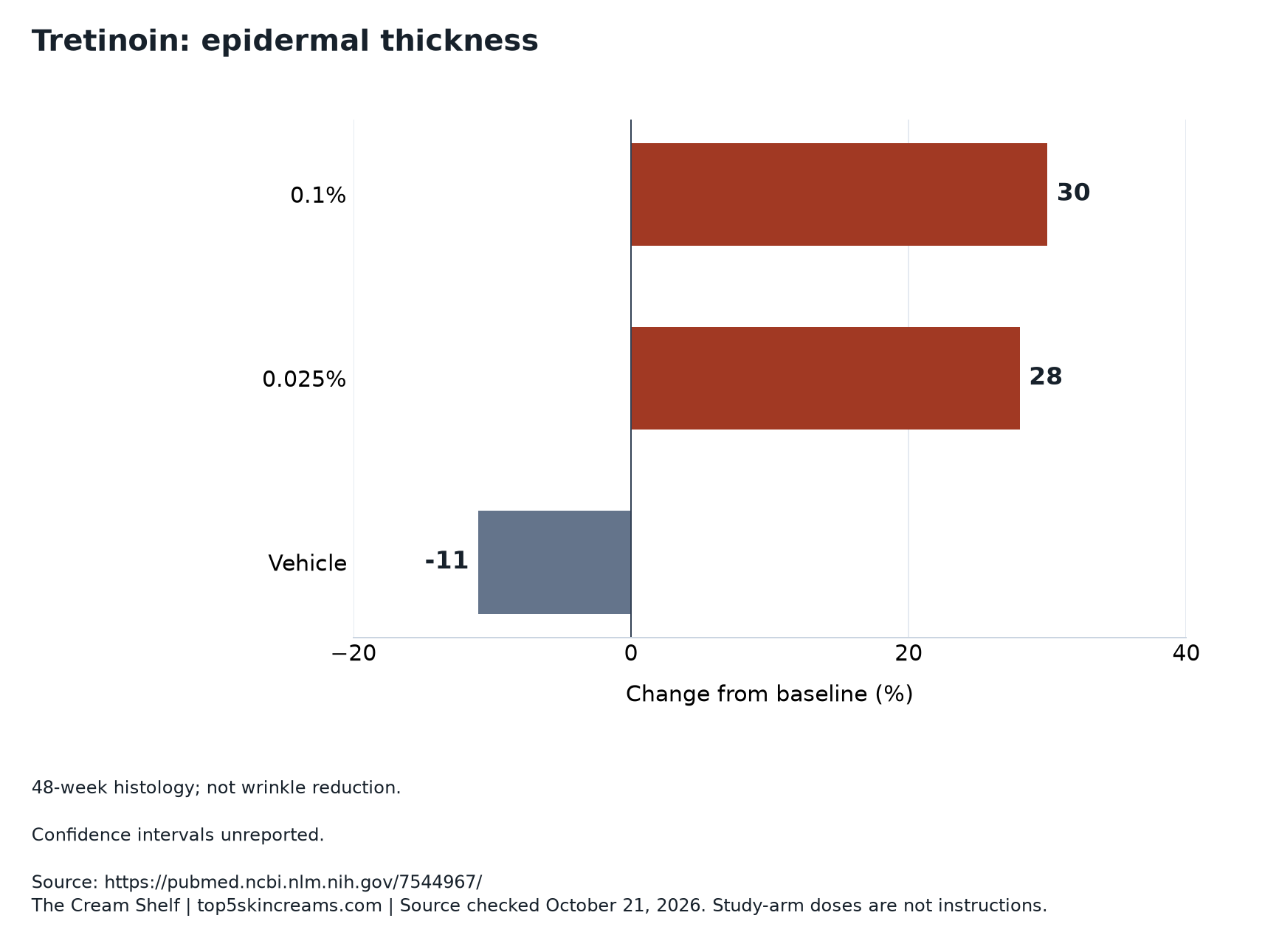
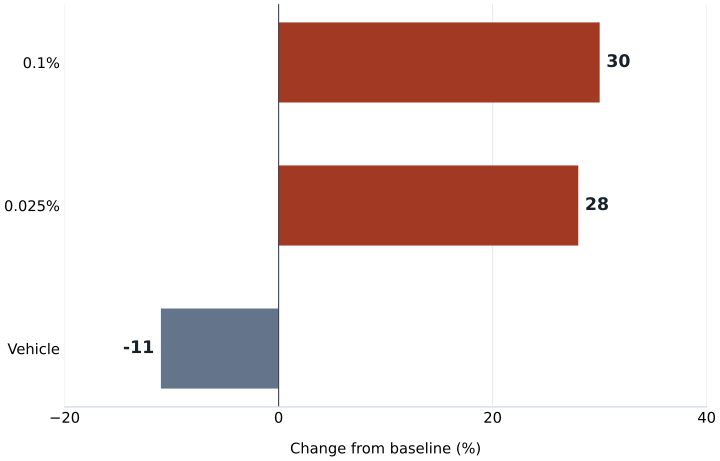
Tretinoin: epidermal thickness
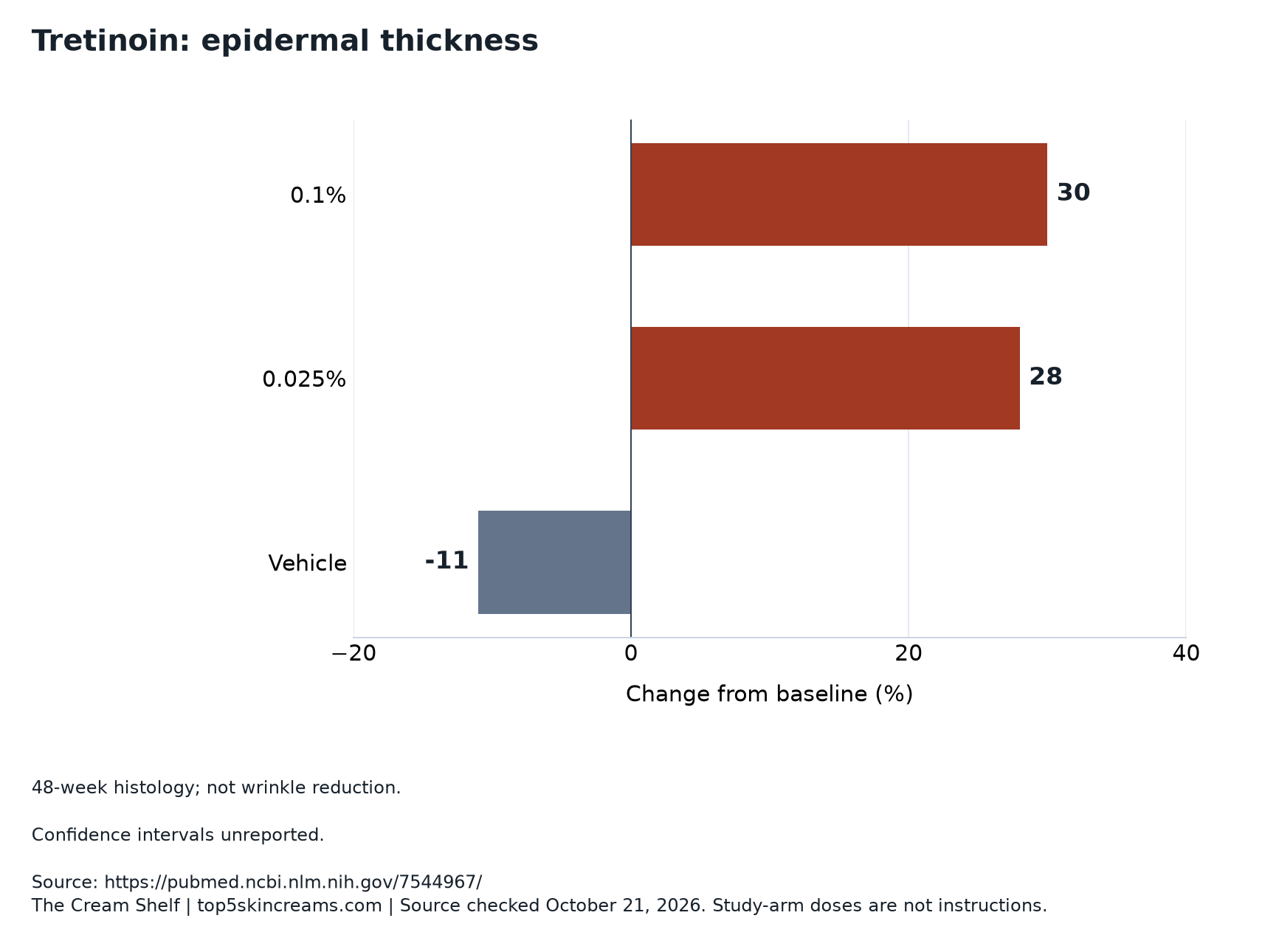
48-week histology; not wrinkle reduction.
Confidence intervals unreported.
Download chart (PNG)Download data (CSV)Download vector chart (SVG)
| Study arm | Reported value |
|---|---|
| 0.1% | 30 |
| 0.025% | 28 |
| Vehicle | -11 |
From separate findings to a combined question
The indexed abstract of the 48-week, double-blind photoaging comparison reports 99 completers: 32 using 0.1% tretinoin cream, 35 using 0.025%, and 32 using vehicle. Both active groups improved facial clinical assessments relative to vehicle, without a significant difference between concentrations; redness and scaling were greater with 0.1%. Initial enrollment, allocation method, confidence intervals and participant-level benefit–irritation overlap are unreported. Funding is unestablished from this limited access. Similar observed responses do not establish equivalence.
The methodological question is whether two separate descriptions can support one combined conclusion. Imagine reading a benefit result first and a reaction result later. Each answers a legitimate question, but placing them beside one another does not match the records of individual participants. A claim about improvement without a defined adverse experience requires that matching step. It also requires an explicit definition of what counts as improvement and which reactions count against the desired outcome.
That distinction changes the reading task. Instead of asking which percentage on a package looks preferable, ask what outcome the evidence actually permits the reader to compare. The existing retinoid ingredient guide covers the identity question; the additional task here is to specify a combined outcome before interpreting a study as establishing one.
Define the two outcomes before joining them
A joint outcome is an event defined by two conditions in the same observational unit. For this question, one condition might be a prespecified improvement on an appearance scale; the other might be absence of a particular reaction above a prespecified severity threshold. Those definitions are proposed measurement choices, not thresholds validated here. They must be selected before examining which definition makes a treatment look most favorable.
The word improvement needs more detail than a change in the desired direction. A research protocol could distinguish a measurable change from a change judged meaningful by participants. Likewise, no severe reaction is different from no reaction of any kind. Both can be sensible research questions, but their answers cannot be exchanged silently. The table offers a conceptual checklist for defining the question rather than a clinical grading system.
The unit matters too: a person, one side of a face and a treated patch of skin are different units. If benefit is measured at one site and discomfort at another, combining them needs a stated rationale. The evidence guide provides the broader document-reading context. Here, an exact endpoint definition is what makes the later count interpretable.
| Decision to specify | Information needed | What ambiguity it prevents |
|---|---|---|
| Benefit threshold | Named scale, direction and required change | Any detectable change becoming a meaningful benefit |
| Reaction threshold | Named symptom, severity and observation window | Different adverse experiences being treated as identical |
| Unit of analysis | Person or explicitly defined treated site | Outcomes from different units being joined |
| Incomplete record | Rule for unobserved benefit or reaction status | Missing information being counted as success |
Identical totals can conceal different experiences
Consider an entirely invented study of 100 people followed over the same period. Suppose 60 meet a defined improvement criterion and 40 experience a defined reaction. These totals alone do not say how many people satisfy both conditions. In hypothetical scenario A, none of the 60 who improve has the reaction. In scenario B, all 40 people with the reaction are among the 60 who improve. The table lays out the complete accounting for those two possible arrangements.
Both scenarios reproduce the same separate totals. Yet improvement without that reaction occurs in 60 people in A and 20 in B. The overlap can range from zero to 40 because it cannot exceed the smaller of the two groups; zero remains possible because the separate counts sum to the full cohort. Subtracting the possible overlap from the improvement count produces the range of 20 to 60. Every number in this exercise is invented, not estimated from a retinoid trial.
A common shortcut would subtract the reaction percentage from the improvement percentage and label the answer net benefit. That subtraction would give the same number for both arrangements, despite their different joint experiences. It is not a count of people helped without the defined reaction unless the necessary overlap conditions are known. The exercise demonstrates an information gap, not a probability forecast for an individual.
| Joint outcome | Scenario A | Scenario B |
|---|---|---|
| Improvement without the defined reaction | 60 | 20 |
| Improvement with the defined reaction | 0 | 40 |
| Defined reaction without improvement | 40 | 0 |
| Neither condition | 0 | 40 |
The observation window changes the question
A joint outcome also needs a clock. An appearance assessment at the final visit and a reaction recorded at any time during follow-up describe different stretches of experience. Joining them can be appropriate, provided the definition says so. It would then ask whether someone met the appearance criterion at the end without experiencing the specified reaction during the entire interval. That is different from asking whether both favorable conditions were present on the final day.
An invented example makes the distinction clearer. One participant has a brief early reaction and meets the benefit criterion at the final visit. A second has no early reaction but reports persistent discomfort at that visit. A rule based on any reaction could place both outside the favorable joint category. A rule based only on final-visit symptoms could separate them. Neither rule tells the whole story without the time course, and changing rules after seeing the results would change the claim.
For a proposed study, repeated symptom records and planned appearance assessments could preserve this sequence. A useful display would distinguish onset, resolution and recurrence instead of compressing everything into ever or never. The routine and product-role guide addresses a different question about organizing products; a research timeline describes what was observed, without turning historical study exposure into personal use instructions.
Severity and duration should remain visible
The current RENOVA label concerns tretinoin cream 0.02% as an adjunct for fine facial wrinkles alongside comprehensive skin care and sun avoidance. It reports local reactions and about 4% discontinuing the drug because of adverse reactions. Its safety and effectiveness limits beyond 52 weeks and above age 71 are product-specific; other studies do not remove them.
For a proposed joint endpoint, reaction severity, duration and consequence should be separately described. A symptom that resolves quickly and a symptom that persists may share a name while representing different experiences. A report can retain both the frequency of a defined event and a description of its course. Combining them into one score would require an explicit justification for how the different experiences were weighted; arithmetic alone cannot supply that judgment.
It is also useful to distinguish an observed symptom from an action taken in response. A temporary interruption, discontinuation of a product and withdrawal from research follow-up are different events. Counting them as interchangeable would obscure both tolerability and missing information. These are editorial distinctions for reading records, not instructions for managing a reaction. The moisturizer and formulation-role guide can help separate product categories without implying that one category cancels another product’s risks.
Missing follow-up can alter the apparent overlap
The full retinol paper describes a 24-week randomized upper-inner-arm comparison of laboratory 0.4% lotion and vehicle: 36 enrolled, mean age 87; 23 completed and 13 withdrew, including three for irritation or itching. Its clinical table carries earlier observations forward. Four inventors disclosed conditional patent royalties, not confirmed payments; no separate funding statement was located in the accessed article.
The general problem is that a final joint classification needs both parts of the record. If a participant reports a reaction but has no later appearance assessment, the reaction is known while the benefit status remains unresolved. Excluding that person would answer a question about the retained group. Calling the person a failure would answer another question under a chosen rule. Neither operation recreates the missing observation. A transparent analysis identifies the choice and explains why it fits the question.
Carrying an earlier value forward is one way of completing an analysis dataset, but the inserted value is not a new examination. A proposed sensitivity analysis could show how the joint result changes under several explicit assumptions about missing outcomes. It should separate assumptions about appearance from assumptions about reactions. The companion retinol study guide examines the distinction between overall observed change and the added effect associated with the experimental comparison.
Compare the combined outcome with its uncertainty
If a future study reports the proportion meeting a prespecified joint endpoint in each group, the next step is to compare those proportions with uncertainty. An invented difference of five percentage points is incomplete without knowing how precisely it was estimated. A narrow interval and a wide interval around the same estimate support different levels of confidence about the range of plausible effects. No such example should be inserted into a historical report as though it were an omitted result.
Uncertainty also belongs to the outcome definitions. A study could report its main endpoint and then show whether conclusions change under alternative thresholds chosen in advance. That is different from trying numerous definitions and highlighting only the favorable one. Readers need to know which analysis was primary, which was a sensitivity check and which was exploratory. A collection of significant results does not by itself identify a coherent benefit-and-tolerability criterion.
A claim of similar overall experience needs still more care. Failing to detect a difference does not demonstrate that any possible difference is small enough to disregard. A study designed to establish an acceptable degree of similarity needs a justified margin and an analysis suited to that purpose. The margin is a substantive judgment about the question, not a value that can be inferred from a nonsignificant result.
Keep tissue measurements in their own column
The accompanying figure concerns epidermal thickness, not wrinkle improvement or irritation. Its units should remain attached to that tissue endpoint. A graph can be accurate and still answer a different question from the one a reader hopes to resolve. Before combining evidence, identify whether a measurement describes microscopic structure, an assessed appearance change, a symptom or a participant’s evaluation of the experience.
In an original conceptual study, a tissue measurement could be collected alongside both clinical outcomes. The resulting dataset would permit questions about whether the measures vary together. Even then, association would not make them interchangeable. A tissue change would not automatically identify who crossed the appearance threshold or who avoided the defined reaction. Replacing those clinical observations with a laboratory measurement would require additional evidence that the substitution preserves the intended interpretation.
This is a problem of endpoint translation rather than a reason to disregard laboratory research. Tissue measurements can develop a scientific explanation while a separate clinical analysis addresses the experience of treatment. A clear report can present both without manufacturing one composite verdict. The existing comparison of retinoid routes supplies product-category context; it should not be read as a conversion table between tissue findings and consumer outcomes.
Longer observation still needs matched outcomes
The 2005 randomized study abstract reports 204 treated participants and greater facial clinical improvement with 0.05% emollient tretinoin than vehicle over up to two years, without usable effect magnitudes. The publisher acknowledges OrthoNeutrogena support and employment, equity, research-support or consulting relationships. Access here includes the abstract and those disclosures, not full methods and results.
Longer observation expands the period over which a question can be studied; it does not automatically fill every cell in a joint-outcome table. A proposed long-term report should identify who remained observed, how outcomes were assessed after interruptions, and whether the same definitions were retained. Otherwise an early benefit measure and a later reaction measure might be combined as though they described the same group under the same conditions.
Funding and financial interests belong in the reading record because they help readers inspect the research setting. Their presence neither computes an effect nor proves that a result is false. The useful response is to examine the design, reporting completeness and reproducibility of the analysis. Separately, the Likeness Rx review can be consulted for documented service and purchase terms; linking that record does not attribute any study outcome to the provider.
What a decision-relevant report would contain
A stronger report would show the separate benefit and reaction outcomes, their participant-level overlap, the time window, and the number with incomplete information. It would describe severity and duration without forcing every experience into one numerical tradeoff. For a comparative claim, it would also retain the control group: a favorable joint outcome in an active group alone does not establish how much that intervention changes the outcome relative to its comparator.
The report could then state exactly which question it answers. Improvement at the final visit without a persistent reaction is one question; improvement without any recorded reaction is another. A reader might reasonably care about both. Presenting the two analyses openly is more informative than allowing a single favorable label to imply that every definition leads to the same conclusion. Any proposed preference weighting should be identified as a separate judgment and tested for how it changes the interpretation.
For shopping decisions, the editorial implication is to keep the evidence question and the contract question explicit. The Curology HydroTret Rx review is a place to inspect documented offer details, not a substitute for participant-level trial evidence. A defensible assessment should say what was measured, what remains unresolved and what additional reporting would close the gap. It should not manufacture a universal concentration ranking from an incomplete combined outcome.
Questions about the evidence
Can benefit minus reaction frequency be called net benefit?
Not without a defined interpretation. Subtracting separate percentages does not reveal which people experienced both outcomes. It also silently treats a benefit and a reaction as quantities that can cancel one another. A proposed net-benefit score needs explicit weights and a justified purpose; a participant-level joint outcome instead counts people meeting stated conditions.
Is improvement without any reaction the only useful endpoint?
No. It is one possible definition, and it may conceal distinctions in severity or duration. A research report could examine several prespecified questions, such as improvement without a persistent reaction and improvement without a particular severe event. Keeping the definitions visible lets readers understand why the resulting counts might differ.
Why cannot missing final assessments simply be ignored?
Ignoring them changes the population described by the result. If the question concerns everyone entering the study, an analysis restricted to complete records needs a reason that the restriction will not distort that answer. Sensitivity analyses make alternative assumptions visible; they do not turn unobserved outcomes into known experiences.
Would a graph of tissue change settle the combined question?
Only if the intended outcome were that tissue measurement itself. A question about appearance together with tolerability requires observations that correspond to those conditions. A graph should retain its own endpoint and units rather than acquire a broader clinical meaning through its placement beside a favorable product description.
What would justify saying two options have a similar overall experience?
The claim would need a stated definition of overall experience, comparable observation periods, suitable data and a justified standard for how close the results must be. A lack of statistical significance alone does not supply that standard. Reader preferences and research uncertainty should remain distinguishable from the numerical comparison.
Editorial assessment
A precise combined-outcome question asks whether the research records connect the desired benefit and tolerability conditions in the same people over an explicit period. The original arithmetic exercise shows why matching matters: identical separate totals can describe different joint experiences. Better reporting would preserve that overlap, symptom severity and duration, incomplete follow-up, and uncertainty in the comparison. It would also distinguish observed outcomes from the judgments needed to decide which tradeoffs matter. This framework supports more precise reading of a cream claim without assigning clinical weights, selecting a concentration or attributing historical study results to a provider.
Research access and limitations
This is an editorial analysis of outcome reporting, not an individualized treatment assessment. The invented tables and examples illustrate measurement choices and arithmetic; they are not reconstructed participant data, validated clinical thresholds or forecasts. Access differs among the cited records as described in the relevant sections. No unreviewed protocol, supplement or individual dataset is assumed.